Most off-the-plan sales teams already use some digital tools in their displays, like slideshows, CGI fly-throughs, maybe a basic touch screen that runs off a brochure-style website. The intent is good, but the result can end up feeling disjointed. One agent jumps between Windows folders, another scrolls through a browser and a third grabs a paper price list because it feels faster.
That workflow wastes the potential of your display suite. In that room is a captive, qualified audience, but it’s missing a consistent, structured way to lead them from curiosity through clarity to commitment.
Custom-built sales apps, like iCreate’s digital interactive sales displays, centralise all the content, logic and data behind your project and present it in a way that matches how buyers actually decide. They also plug into your CRM and marketing systems, so every conversation creates reliable data and follow-up, without your team doing manual admin.
When you treat a sales app as your core sales tool rather than an upgraded slide deck, your display suite becomes a controlled environment instead of organised chaos. Let’s break down what that looks like in practice and how it changes commercial outcomes for off-the-plan projects.
1. Treat your sales apps as infrastructure, not a slide deck
Strong off-the-plan campaigns don’t happen by accident. They run on systems. The first step is to stop thinking of a sales app as ‘just something on the TV’ and start treating it as the underlying infrastructure that holds your sales process together in the display suite.
When you do that, the benefits show up in how confidently your team moves and in how much mental load you remove from both your agents and your buyers.
Replace fragmented tools with one sales operating system
Walk through a typical sales appointment today and you’ll probably see 4 or 5 tools in play, like email attachments for latest price lists, Dropbox or SharePoint folders for renders, PDFs for floor plans, a web browser for the project website, plus the CRM sitting in another tab. Each tool is essential for selling off-the-plan, but using them like this creates friction.
Custom-built sales apps consolidate all of that into a single interface. At iCreate, we run the application via secure web URL, so your team can access the same environment from TVs, touchscreens, tablets or kiosk-mode PCs. No proprietary hardware, no device lock-in, and multiple users can run sessions at once through agent and public modes.
In real terms, that means an agent can move seamlessly from masterplan to precinct. They can navigate from a tower or house and land release to a specific apartment, townhouse or lot. They can toggle interior schemes or façade options, show views, highlight inclusions and capture buyer details, all without switching context or reloading anything. The app carries the logic of the project structure, so your team doesn’t have to hold it all in their heads.
This single-system approach frees your team to focus on listening and shaping a deal. When the operating system of the sales room works smoothly, your best sales skills finally sit in the foreground.
Structure every conversation around buyer decisions
Most developers and property marketers have a clear vision of how their development’s story is told: location, lifestyle, architecture, amenity, then product detail and numbers. But in reality, agents will jump to whatever asset they can find quickest. Important proof points get skipped when the room fills up.
Purpose-built sales apps bake the ideal flow into the interface. You can guide a buyer from a high-level aerial that positions the project into an interactive masterplan, then down into building or lot choice, and finally into a detailed apartment view with floorplan, finishes and key selling points. At each step, the app can bring up prompts, talking points and content that match common objections or questions.
This does two things.
- It protects the integrity of your story when a new agent joins the team or a seasoned agent has a long day.
- It ensures each buyer sees the elements they need to gain certainty, rather than a random subset based on how stressed the sales floor feels.
Data from interactive experiences across the sector shows that when buyers explore this kind of structured, visual content, they stay engaged 2 to 3 times longer and move through decisions with more confidence.
Once you experience a display session where every buyer walks the same well-designed path, you start to see the app less as a gimmick and more as the backbone of your sales method.
Slow prospects down to speed decisions up
Off-the-plan selling sits in a strange space. You want momentum, but you also want buyers to look at the details long enough to feel confident to purchase. Good sales infrastructure does something counterintuitive. It slows buyers down at the right parts of the conversation.
When a buyer stands in front of a large screen and starts filtering by budget, aspect, bedroom count and level, they invest effort. When they slide between colour schemes or appliance packages, they begin to picture themselves in the space. That extra dwell time is the mental work that leads to commitment.
Our sales apps support shortlisting and branded buyer summaries, so the agent can generate a neat summary of the exact apartments discussed, with key notes, pricing and next steps. The buyer leaves with something specific and personal, and your CRM receives structured data about what they liked.
This combination of deliberate slowing in the right moments and clear, documented outcomes at the end makes decisions feel less rushed and more grounded. That shift reduces second thoughts and keeps your follow-up aligned to what the buyer actually processed in the room.
2. Build brand-consistent experiences that sell the promise
Many display suites still rely on generic templates or off-the-shelf tools that wash away the character of the developer brand. Sales apps turn your display into a fully branded environment that looks and feels like an extension of your project, not a skin on a third-party product.
Make your project feel proprietary, not generic
Template-based software forces your project into someone else’s grid. Fonts, colours and layouts follow defaults, so your brand fights for space inside an interface that looks similar to what every other developer uses. High-value buyers notice that disconnect, even if they can’t always articulate why.
When we design sales apps, typography, layout, iconography, motion and micro-interactions all align with your existing guidelines. The app can borrow cues from your website and campaign work, so the transition from ad to website to display feels continuous. That continuity matters. Research shows consistent visual identity boosts recognition by around 80% and increases perceived value by low double digits.
The psychological effect in a display suite is simple. When buyers sit in a space where the physical environment, printed material and digital interface all carry the same design language, they read it as competence and control. You appear organised and serious about the project. That impression helps justify price, especially in premium segments where buyers pay attention to detail.
Use interactive visuals to overcome the off-plan confidence gap
Every off-the-plan team knows the core challenge is that buyers have to commit to something they can’t yet walk through. The better you bridge that comprehension gap, the easier your sales process becomes. High-quality 3D renders and VR already help. Interactive digital displays go a step further by giving buyers control.
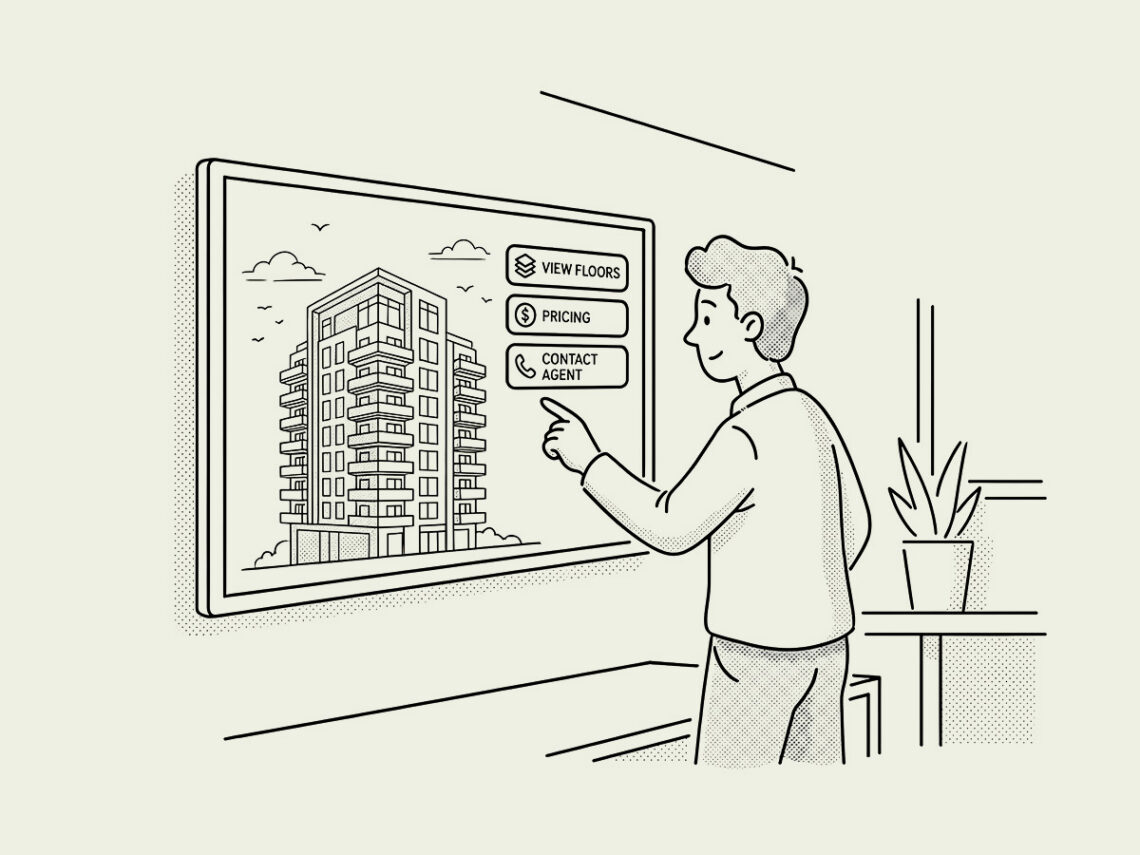
Our platform supports interactive masterplans, tower explorers, panoramic view embeds, interior scheme toggling, finishes and inclusions highlights. A buyer can select a level, tap a specific unit, see the view and compare schemes in real time. These interactive visualisations have driven up to 40% higher conversion rates and hold attention several times longer than static boards or video loops.
This level of detail answers the questions that stall deals, like ‘How dark will this kitchen feel?’, ‘What exactly do I see from level 17, north-west?’ or ‘Where do my kids walk to school from here?’.
When you can put answers on-screen, backed by clear visuals, you reduce the mental distance between marketing promise and lived reality.
Standardise stories across every agent and appointment
One of the most common complaints from developers is inconsistency between agents. The principal knows the project story inside out. Senior staff do a good job. Casuals and contractor agents vary. Over the course of a campaign, that variation shows up in misaligned expectations, confused buyers and deals that fall through because someone framed a detail differently.
Sales apps don’t replace training, but they act as a shared script that no one forgets. The interface nudges agents through the right sequence of topics, with the right visuals at each step. It also hides content that should stay internal, through an agent mode that unlocks deeper data and a public mode suitable for self-driven browsing.
From a brand point of view, this is huge. It means every buyer, whether they attend on a quiet Wednesday or a hectic launch weekend, experiences the same core story with the same supporting assets. Over time, that consistency protects your reputation and saves you time unwinding misunderstandings after contracts go out.
3. Fix data friction with deep CRM integration
You’ve set up a serious CRM system, yet agents in display suites collect details on paper or in ad-hoc forms, then someone keys everything into the CRM later. Leads go missing, and duplicates can appear. If sales apps are well integrated, they turn every interaction in the display into structured data that flows through your systems in real time.
Capture clean data at the source
The quality of your CRM depends on what goes in. When sales teams rely on manual entry, accuracy suffers. Industry studies show sales reps often spend up to 40% of their day on admin and still produce incomplete records. Automated capture through an integrated app solves both problems.
We connect our sales apps directly into CRMs and marketing platforms that support APIs or form-based integrations, including Salesforce, Hubspot, ActiveCampaign, Mailchimp, Campaign Monitor and many more property-specific CRMs. When a buyer shortlists apartments, requests a brochure or submits an expression of interest, the app can push that profile straight into one or more systems with clear data tracked to that lead.
AI-powered CRM automation in broader markets achieves data accuracy rates around 98% and eliminates much of the duplication that creeps in when different agents key in the same buyer slightly differently. For you, that means one clean record per person, clear attribution back to the display channel and no wasted effort reconciling spreadsheets with CRM exports at month-end.
Respond at the speed modern buyers expect
The timing of your follow-up matters as much as the content. Teams that respond to an enquiry within five minutes see conversion rates up to 80% higher than teams that take even half an hour. In off-the-plan, where buyers often tour multiple projects in a short window, speed becomes a deciding factor.
Feeding leads from sales apps instantly to your CRM can trigger smart responses in your automation. This could include a personalised email summarising the shortlist they built in the display, a text from the agent with a direct reply to a key question or even a calendar link to lock in a finance review.
The important point is that your digital display doesn’t just create a better in-room experience. It sets up the next steps so they happen quickly and consistently. You stop relying on agents to get to the admin later and start treating response speed as a system feature.
4. Design once and scale across projects and stages
Developers who only ever plan a single boutique project can treat each display as a one-off. Anyone managing multiple stages, towers or precincts needs a different approach. Rebuilding websites, apps and tools from scratch for every release drains resources and introduces inconsistency.
Well-designed custom sales infrastructure solves this by giving you a reusable base you can adapt as your portfolio grows.
Reuse infrastructure across towers, stages and precincts
iCreate sales apps support cross-project switching and staged rollouts. That means a single app instance can present Project A today, switch to Project B in another suburb and then add Stage 2 of Project A as it comes online, without a rebuild. You can even layer in new components over time within the same system.
From an operations point of view, this matters because your team learns one interface. Agents who master the app on one project move seamlessly onto the next. You avoid the fatigue that comes with onboarding new tools for every launch.
The infrastructure essentially becomes your internal standard for how projects go to market in a display environment.
Cut marginal launch cost whilst improving quality
Custom development will always require a higher upfront investment than a template subscription. The economics change when you stretch that investment across multiple launches. Custom real estate apps demonstrate conversion rates around 5%, compared to 2% for generic templates, which works out at a 150% performance advantage. When you run several launches through the same platform, that uplift compounds.
The more projects you bring onto the platform, the lower the effective per-project cost of the initial build. Future releases become configuration exercises rather than development projects. We swap in new masterplans, renders and pricing, but the underlying engine stays the same. You also save on the indirect cost of errors and delays that come from spinning up new tech stacks each time.
Use the platform as a live training and coaching tool
A side effect of structured sales infrastructure is that it doubles as a training tool. New agents learn by driving the app in real appointments, following the same flow their colleagues use.
Sales leaders can sit in on sessions, watch how agents move through the content and spot patterns. Does one agent skip the lifestyle section and rush to price? Does another spend too long in features and never progress to commitment? Because the app standardises the journey, you can coach against a clear model.
Over time, the app elevates performance by giving even average agents a strong structure. Your training lifts the ceiling by helping your best people use that structure creatively. Together, they turn your display suite into a place where both buyers and team members gain clarity, instead of a room everyone survives.
5. Build long-term PropTech assets instead of renting templates
Many PropTech tools follow a recurring SaaS model. That suits some parts of a development business, especially where the product must serve many industries. For specialised off-the-plan sales environments, a different pattern makes more sense. Own the infrastructure, keep hosting simple and avoid vendor lock-in that forces you to rebuild when pricing or priorities change.
Own your sales infrastructure and avoid SaaS lock-in
With our sales apps, you invest once in the custom build, then pay annual hosting and, if needed, a bank of support hours. You don’t pay per-seat or per-project multiples in perpetuity. You own the build once complete, and can run it across as many projects and devices as you choose within your own terms.
Custom infrastructure in broader property contexts can cost more upfront than SaaS, yet total cost of ownership often ends up roughly half over 5 years compared to subscription tools that charge across users and projects, especially once you layer in increased conversion rates and saved labour. You also avoid the risk of a SaaS provider changing direction and pushing your niche needs down their priority list.
Ownership gives you control. You decide when to extend the platform, when to refresh the design, and how aggressively to roll it out across your portfolio.
Prepare your organisation to get full value from sales apps
Technology alone never fixes sales. The teams that get the most from custom sales apps treat implementation as a change project, not just a procurement exercise.
That means bringing sales and marketing into the design process early, so the app reflects real conversations rather than idealised ones. It also means setting simple usage standards, like every appointment running through the app, every expression of interest getting logged via the app or every new agent learning the app as part of onboarding.
Once you embed those habits, the app’s benefits multiply. Your conversations become more consistent, your data becomes more trustworthy and your leadership gets visibility across projects. Buyers will feel the difference the moment they walk into the display.
Turn every display conversation into a controlled advantage
Off-the-plan marketing already asks more of you than built-ready stock, with longer sales cycles and buyers who commit based on faith in drawings and promises. Running that complexity off PDFs, generic websites and half-connected tools makes the job harder than it needs to be.
Custom digital sales apps, built around your brand, project structure and sales workflow, give you something different. They turn your display suite into a controlled environment where content flows logically, agents tell the same story, data captures cleanly into your CRM and the infrastructure scales across towers, stages and future projects.
For more information about how we can create interactive digital sales apps for your project, schedule a call with us today.