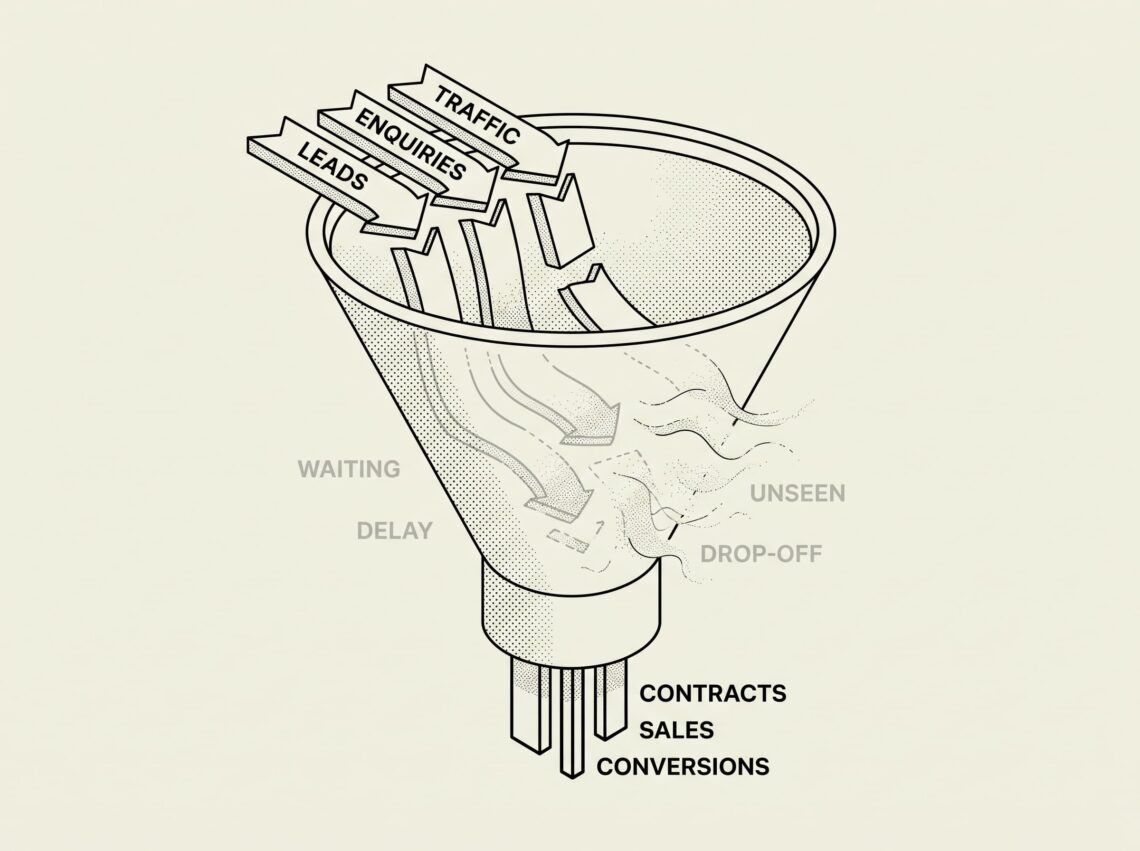
There’s a pattern that repeats across property developments of every size and market. Campaigns are generating solid traffic. Off-the-plan enquiries are rolling in at a volume that should be translating into presales momentum. And yet, somewhere between that first enquiry and a signed contract, things slow down, and it’s difficult to pinpoint why.
Marketing reports healthy numbers, but the sales team says the leads feel soft. The truth is, both sides are drawing on accurate data from their own slice of the process, and the disconnect between those two truths is exactly where off-the-plan campaigns bleed out. The problem almost never sits where people think it does, and until someone names it, everyone keeps solving the wrong thing.
Convert more off-the-plan enquiries by fixing The Drift
After years of seeing clients suffer the slow, invisible loss of buyer momentum between first enquiry and signed contract, we decided to name it. We call it The Drift, and it lives in the part of the funnel that receives the least strategic attention in most off-the-plan property marketing campaigns.
Property marketing campaigns invest heavily in generating attention through ads, media spend and creative, and the top of the funnel gets properly resourced while the middle gets assumptions. A buyer clicks a lead ad and bypasses the website entirely, capturing data but creating no brand experience and no meaningful reason to choose your project over the next option they encounter. Leads don’t make it cleanly into the CRM. Automation sequences go untriggered. Remarketing audiences are built but never properly activated. The strategy looks coherent in the spreadsheet, but the execution tells a very different story.
Why it stays hidden in your campaign for so long
The Drift is expensive because it goes unnoticed for so long. Awareness metrics look healthy, so the presales campaign appears to be working. The real problem, that buyer momentum is leaking steadily between stages, never surfaces in the top-line reporting. By the time the shortfall becomes undeniable, the campaign has been running on a flawed conversion structure for weeks or months.
When presales feel slow, the instinct is almost always to push for more leads. Increase the ad spend, broaden the targeting, run a new creative push. And enquiry numbers duly go up. But if the underlying progression structure hasn’t changed, more leads simply means more buyers entering a broken funnel at greater cost. The more productive question for any project marketing team in this situation isn’t ‘How do we get more leads?’, it’s ‘What’s actually happening to the leads we already have?’
What the off-the-plan buyer journey really looks like in property marketing
Off-the-plan buyers don’t move in a straight line from interest to contract. They comparison-shop across multiple projects in the same week, raise the decision with their partners, read competing content and can end up talking themselves out of it when no one is actively building their confidence. Buying something that doesn’t exist yet demands a level of trust that resale transactions don’t require, and that confidence erodes quickly when met with radio silence. When a lead expresses interest, then hears nothing for ten days, that silence is filled by every other source of influence except yours.
The most fragile point in any off-the-plan sales campaign is the transition from enquiry to booked appointment. This is the stage where interest needs to become genuine commitment. A single follow-up call or, worse, an automated ‘Thanks for getting in touch!’ email, rarely bridges that gap for a buyer who is still weighing up if the reality will match the promise. Every touchpoint in that journey either builds confidence or introduces doubt, and the projects that consistently convert treat reassurance as an ongoing function of the campaign rather than something that happens at the display suite.
What high-performing projects do differently
The off-the-plan campaigns that hit presale targets ahead of schedule are designed as progression systems rather than collections of individual campaigns. Every touchpoint has a deliberate role, with each piece of content connected to a specific stage in the buyer journey. The strategy is operational, which means it lives in the CRM, the automation, the remarketing sequences and the follow-up timing.
Mapping the actual buyer journey is almost always where the answers are. Where does a lead enter the system? What happens in the first 24 hours? How many touchpoints exist between enquiry and appointment, and how many actually work? Most project marketing teams find the gap between what they believe they have and what genuinely exists is considerably larger than expected. And identifying which stage has the steepest drop-off often creates downstream improvement across multiple stages within weeks.
A conversation the property industry needs to be having
Sonia was recently featured in The Urban Developer, exploring exactly this problem. We’d argue The Drift is one of the most expensive problems in off-the-plan property marketing, and it’s the one that gets the least attention. If your campaign is generating awareness but not generating contracts, the issue is almost certainly structural, and we can fix it.
If you want to map what’s actually happening in your own presales campaign, our Drift Diagnostic Guide is the starting point. It’s a structured framework built from years inside off-the-plan sales environments, designed to trace lead movement from first contact through to conversion or loss and identify exactly where momentum is breaking down. You can download it here.